A lot of the VitalLeaves story starts with a conversation.
Because I am part of the Rasta community, people reach out to ask about plants, bush teas, roots and the kind of knowledge that gets passed from one person to another.
Sometimes I know the answer.
Sometimes I call somebody who knows more than I do.
And sometimes the conversation eventually turns into:
“You have all this knowledge. Why don’t you source, package and sell this plant? You’re in America now! A lot of people need this!”
Hence, VitalLeaves — and eventually, Taylor’s Things.
The knowledge gap became obvious once I left Jamaica
Sometimes you have to leave something familiar before you realize how much value you were surrounded by.
In Jamaica, there is almost always somebody who knows.
You ask about a plant and somebody can tell you what they call it, where to find it, which part people normally use or who you need to talk to next.
Outside Jamaica, people may find a capsule, a powder or a questionable online listing without any of the knowledge that normally surrounds the ingredient.
That knowledge gap is where VitalLeaves begins to make sense.
First we go back to people who know
Before a plant becomes a product, I want the conversation.
What is the plant?
What other names does it have?
Which part is traditionally used?
How was it prepared?
What does it taste like?
Was it normally used by itself?
Who taught you?
Those questions matter because the internet is very good at repeating information after the context has disappeared.
Horny Goat Weed is a good example.
This is not a plant I discovered because it showed up on a trend report.
My children’s grandfather has years of direct herbal experience and played an instrumental role in helping horny goat weed reach a much wider international audience.
So my first question is not:
“What does the internet say I can claim?”
It is:
“What do the people who actually know this plant know about it?”
Bush tea and a retail product are not exactly the same job
At home, bush tea can be wonderfully informal.
A handful of this.
A piece of that.
Taste it.
Adjust it.
That works when the person making the tea already knows what they are doing.
A customer buying a packaged product deserves more consistency.
How much goes into the bag?
How fine is it cut?
How much water?
How long do we steep it?
What does one serving mean?
Can we repeat the experience from one batch to the next?
That is not abandoning the tradition.
It is translating it.
Small batches teach you what the product actually does
A formula on paper is one thing.
A cup is another.
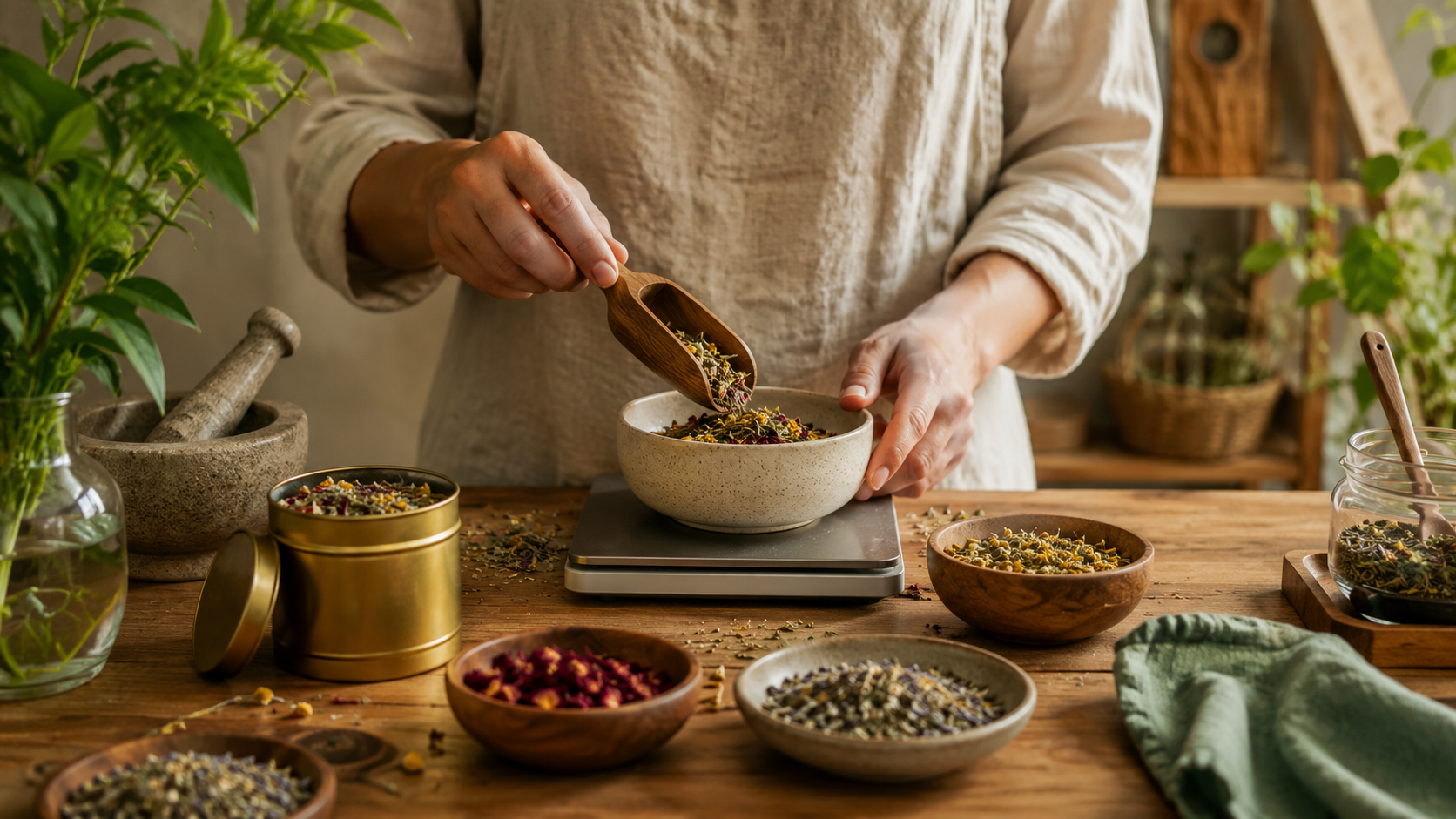
Small batches let us pay attention to what happens when real ingredients meet real water in a real kitchen.
Flavor.
Aroma.
Strength.
How the ingredients settle.
How the blend behaves after storage.
How repeatable the preparation is.
That is where an idea starts becoming a product.
Every plant gets its own story
Medina is not Horny Goat Weed.
Strong Back is not Donkey Weed.
Each plant has its own history, flavor, preparation, reputation and questions that need answering.
So each product gets its own documentation.
That is important because “Jamaican herbs” is not one ingredient.
The plants deserve more respect than that.
Sourcing means finding the actual plant
Once we know what we are looking for, sourcing becomes its own job.
Where was it grown?
How was it harvested?
How was it dried?
How was it stored?
Are we confident about the plant identity?
Whenever practical, we retain direct relationships with Jamaica because the source is part of the point.
But the story on the package has to match reality.
Then comes the part nobody posts on Instagram
Weights.
Ingredient order.
Brewing instructions.
Package dimensions.
Labels.
Lot codes.
Storage.
Consistency.
Closures.
Ingredient lists.
Claims.
This is where an interesting traditional formula becomes something that can responsibly sit on a shelf.
And this is where the turn-the-package-around test shows up again.
The back has to tell the same story as the front.
Formulation does not mean burying the herb
The goal is not to take a Jamaican plant, add so many things that you can no longer taste or recognize it, then put the plant name in giant letters on the front.
A VitalLeaves Horny Goat Weed infusion still has to be a real drinking experience.
Supporting ingredients can shape flavor and aroma. They can make the cup more enjoyable.
But the formula still has to make sense when you turn the package around.
No sugar-and-artificial-flavor circus hiding behind a picture of a leaf.
The label has to be disciplined
Traditional use can be part of the story.
Research can be part of the story.
Neither gives us permission to turn the label into a cure-all.
Food and herbal-product labeling in the United States has rules for identity, ingredient declarations and claims. The FDA’s food-labeling resources are one of the references we use when translating a product into retail packaging.
The product label has a much simpler job than social media sometimes wants it to have.
It tells you what you bought.
Packaging is where the idea becomes physical
There is a moment when the plant is no longer just something being discussed in a conversation.
It is measured.
Packaged.
Labeled.
Held in somebody’s hand.
That is when the mission becomes tangible.
Having Medina, Horny Goat Weed, Donkey Weed and Strong Back available through Taylor’s Things takes that mission from something we can talk about into something physically real.
This is what bringing it to market means to me
A question becomes a conversation.
The conversation leads to knowledge.
The knowledge reveals an opportunity.
The opportunity becomes a product.
And the knowledge moves.
That is the bridge Taylor’s Things is building.
There were people telling me for years:
“You know all of this. You know the people. You have access to the plants. Why aren’t you doing something with it?”
Now the answer is:
We are.
VitalLeaves gives the herbal knowledge a product.
Taylor’s Things gives it a marketplace and a bigger mission.
Taking Jamaican knowledge, giving it a modern way to travel, and making sure the story arrives with the plant.
The knowledge reached us because somebody kept passing it forward.
Taylor’s Things is making sure the chain does not end here.
Leave a Reply